MARTIN KELLAN · EDITION 1.1
THE EIGHT-SYSTEM METHOD
The Lights Go Out. And Everyone In Your House Turns And Looks At You.
Your house runs on eight systems. Find the weakest one before an emergency does — score all eight, and finish your first session with the plan written down on paper. For power outages, severe weather, water advisories and evacuations.
Nobody appointed you to that job. You just have it. This is about the first sixty seconds after the lights go out — and whether you already know what to say.
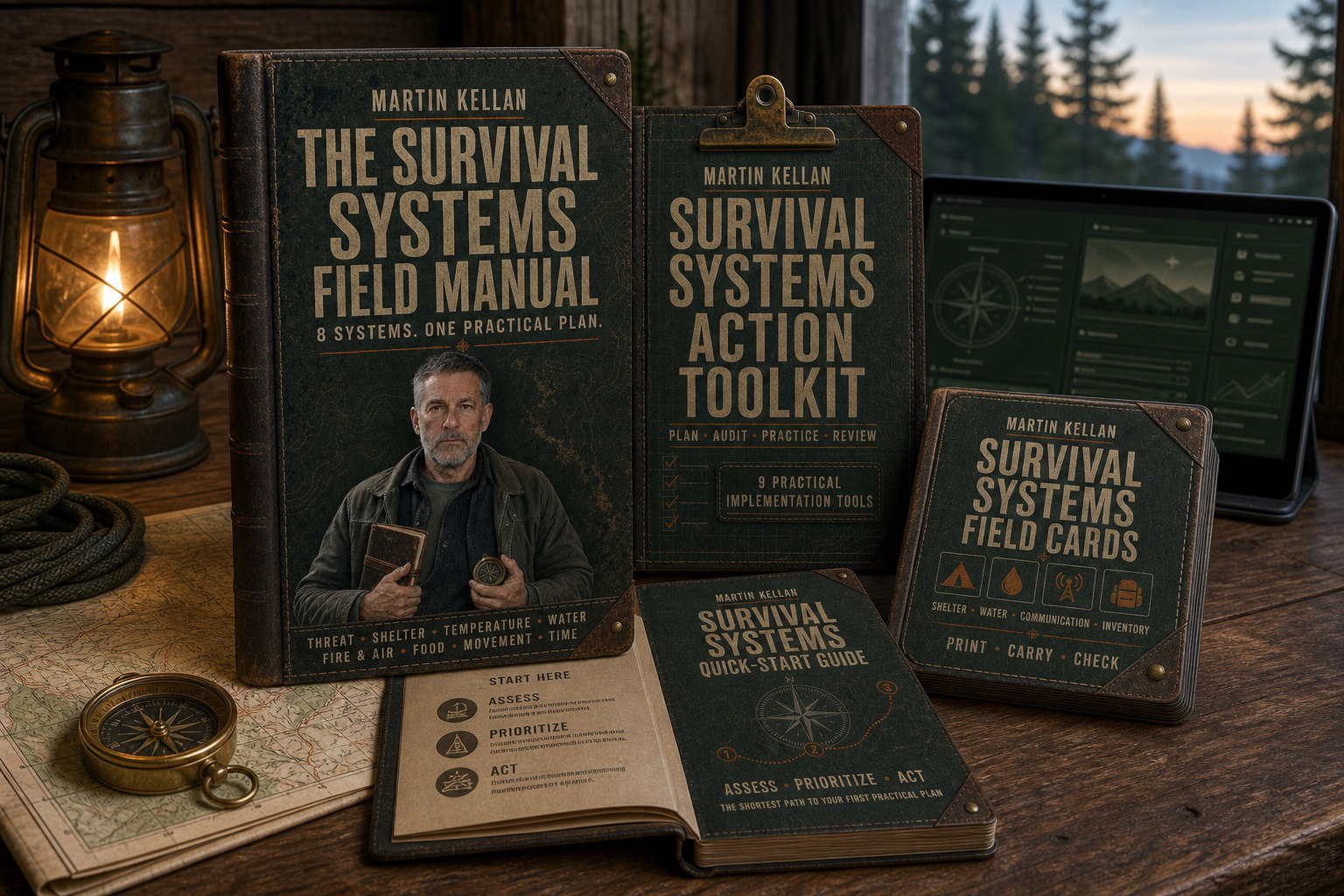
WHAT YOU GET
Five components, with the exact counts. Next to each one is what we would charge for that piece by itself. Add the four together with your finger. Then look at what you pay today.
for all five
Every other number on this page names a federal agency. These four name us — we set them, and we are telling you we set them. Here is the part that matters more: $27 is what we would charge for the field manual by itself, and $27 is the price of all five today. The other four come with it. That is the whole arithmetic. There is no second offer after you click, no upsell, no subscription, and nothing else to buy.
$27 — one payment. No subscription.
Instant access the moment you pay — the complete edition, yours to keep. Nothing ships, nothing renews. 30 days to ask for your money back at support@flowazy.com, no reason needed. Use it first. Decide after.
This is educational planning — not medical, rescue, or legal advice, and no product can guarantee how an emergency turns out.
In The Woods, A Weak System Shows Itself Within The Hour. A House Can Hide One For Years.
Start with the evening it actually happens. Half past seven. The television cuts off mid-sentence and the whole house goes dark at once. Nobody screams. What happens is quieter than that, and worse: everyone in the room turns and looks at you.
In that half second you are running numbers you have never run out loud. Where the flashlight is. Whether the batteries in the drawer are the ones that fit it. Whether the water in the garage is still any good. What you are going to say to them.
Out in the woods you would already know. Out there a weak system tells on itself inside the hour — you are cold, or you are thirsty, or the one thing you need is at the bottom of the pack in the dark. You know exactly which system let you down, because it let you down in front of you.
A house never tells you. Everything looks fine. The supplies are in the closet, the batteries are in the drawer, the water is stacked in the garage. And it keeps looking fine right up until the power fails, the water goes under an advisory, or the road out closes. That is the hour you find out which one was weak, and it is the worst hour there is to find out.
The eight systems are the same eight systems in both places. Only the warning is different.
This is the home version. You find the weak one on an ordinary Thursday evening, with the lights on and nothing happening — which is the only time anybody has ever been able to fix one.
LOOK INSIDE BEFORE YOU DECIDE
Most Pages Like This Show You A Cover. Here Is The Inside.
THE FIELD MANUAL — three real pages
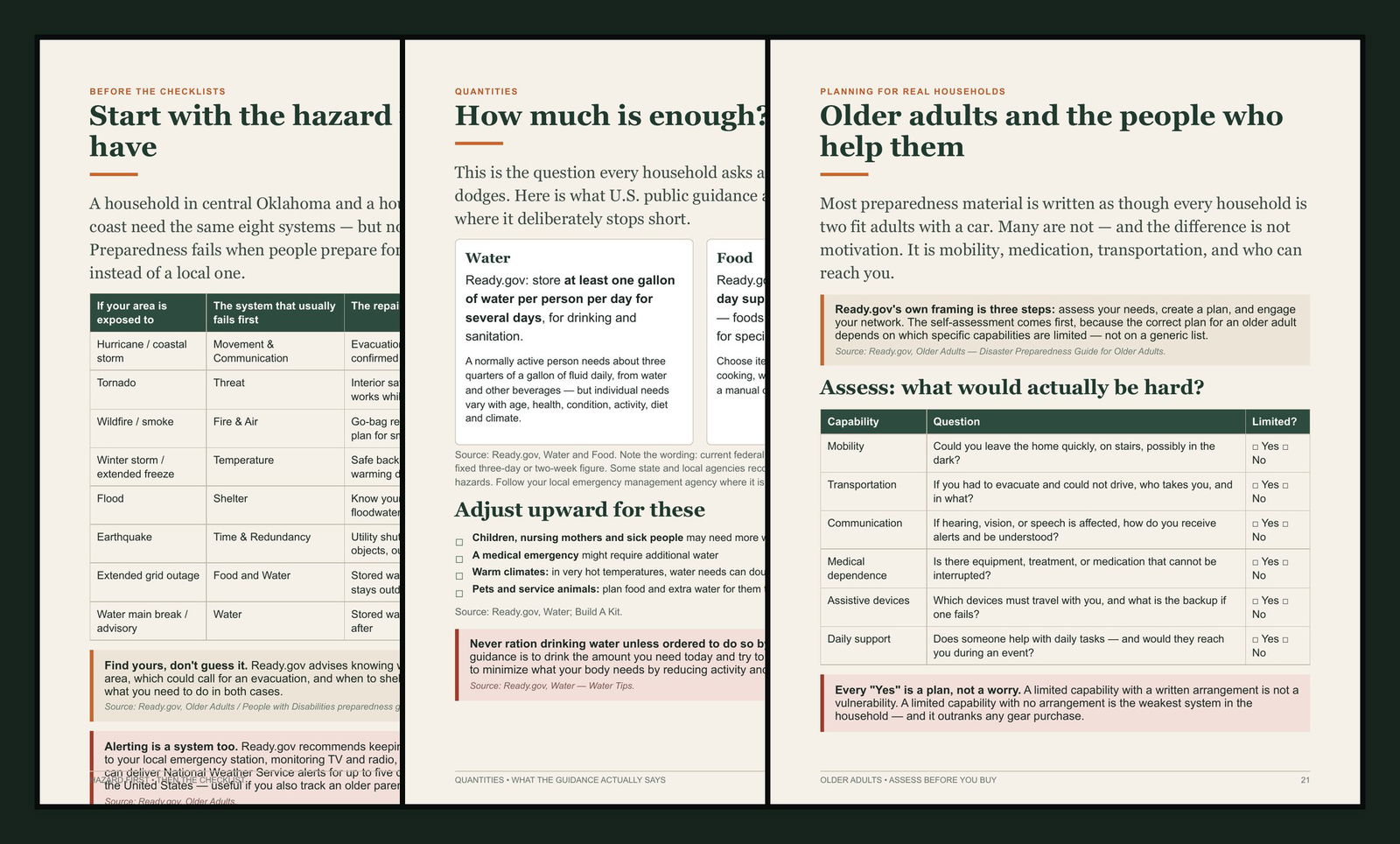
Left to right: the U.S. regional hazard table, the stored-quantities page, and the older-adults self-assessment. Not mockups — pages out of the file you receive.
And this is the detail the whole thing rests on
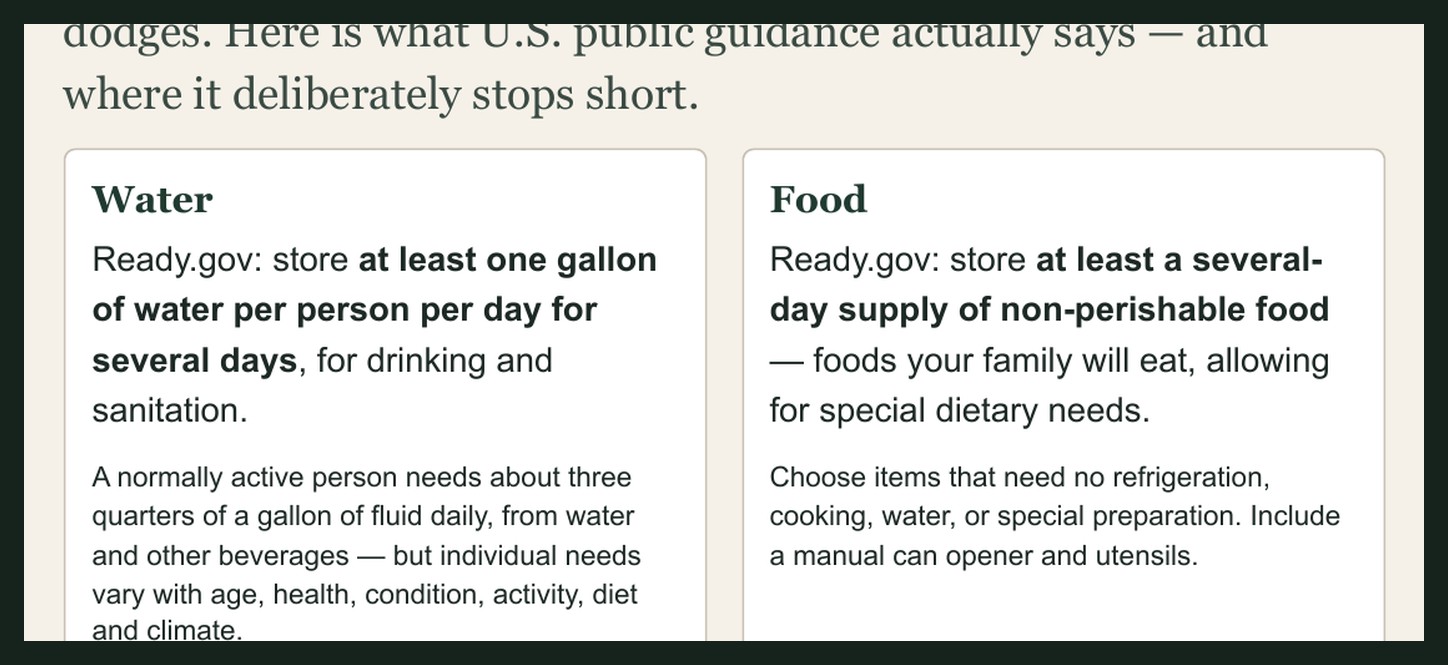
The agency is named on the same page as the number, in the manual's own words — not summarized, not rounded, not made more confident than the source. That is what lets you check this book instead of believing it. It is also why you will not find a bigger promise on this page than the sources support.
THE TOOLKIT AND THE QUICK-START — the pages you write on
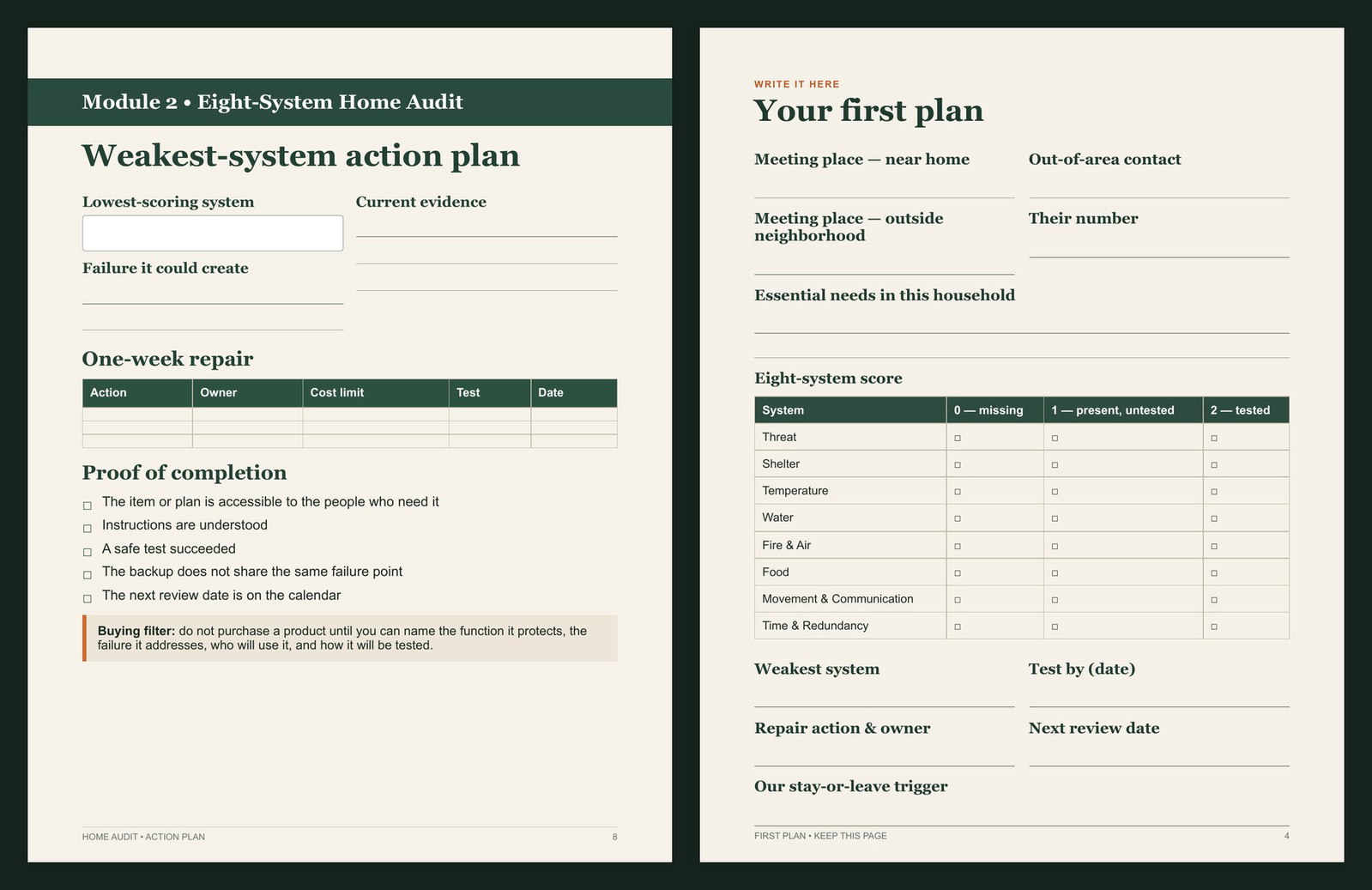
Left: Module 2's Weakest-System Action Plan — the one repair, who owns it, the cost limit, the test, the date. Right: the Quick-Start's first-plan sheet. The blank lines are the product. Reading it changes nothing; filling it in is the whole point.
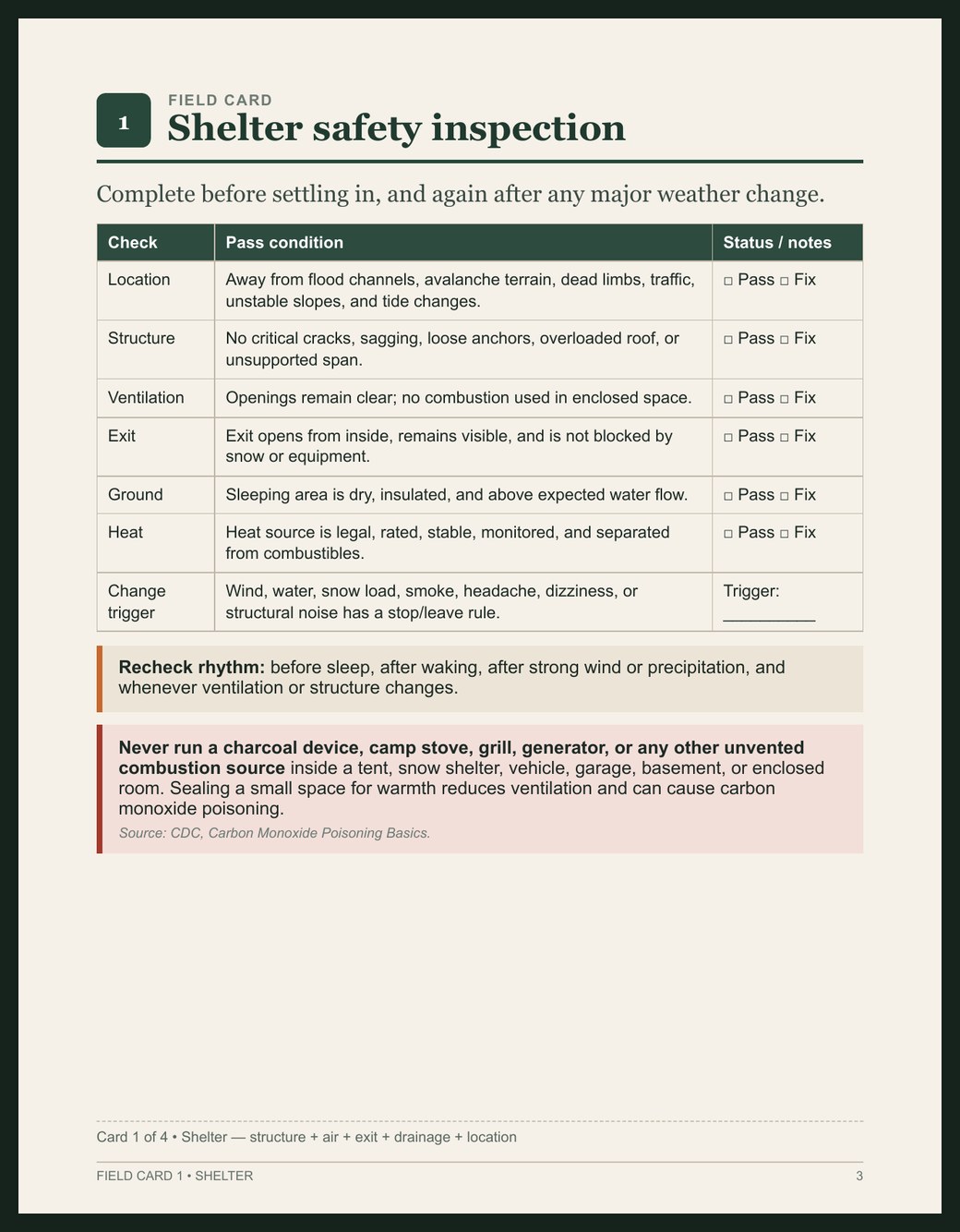
THE FIELD CARDS — one of the four, in full
This one is printed, not scrolled
The shelter inspection card, shown whole. Six checks, each with the condition that counts as a pass, and a seventh line for the change that makes you leave. It prints on one sheet at 100%, in black and white, and it keeps working when the phone is dead — which is the only condition that actually matters for this part of the bundle.
Three more like it: water decision, family communication plan, emergency inventory.

Every one of those pages was written the same way: look up what the agency actually says, print the wording, name the agency beside it.
Buying Supplies And Being Ready Are Two Different Things
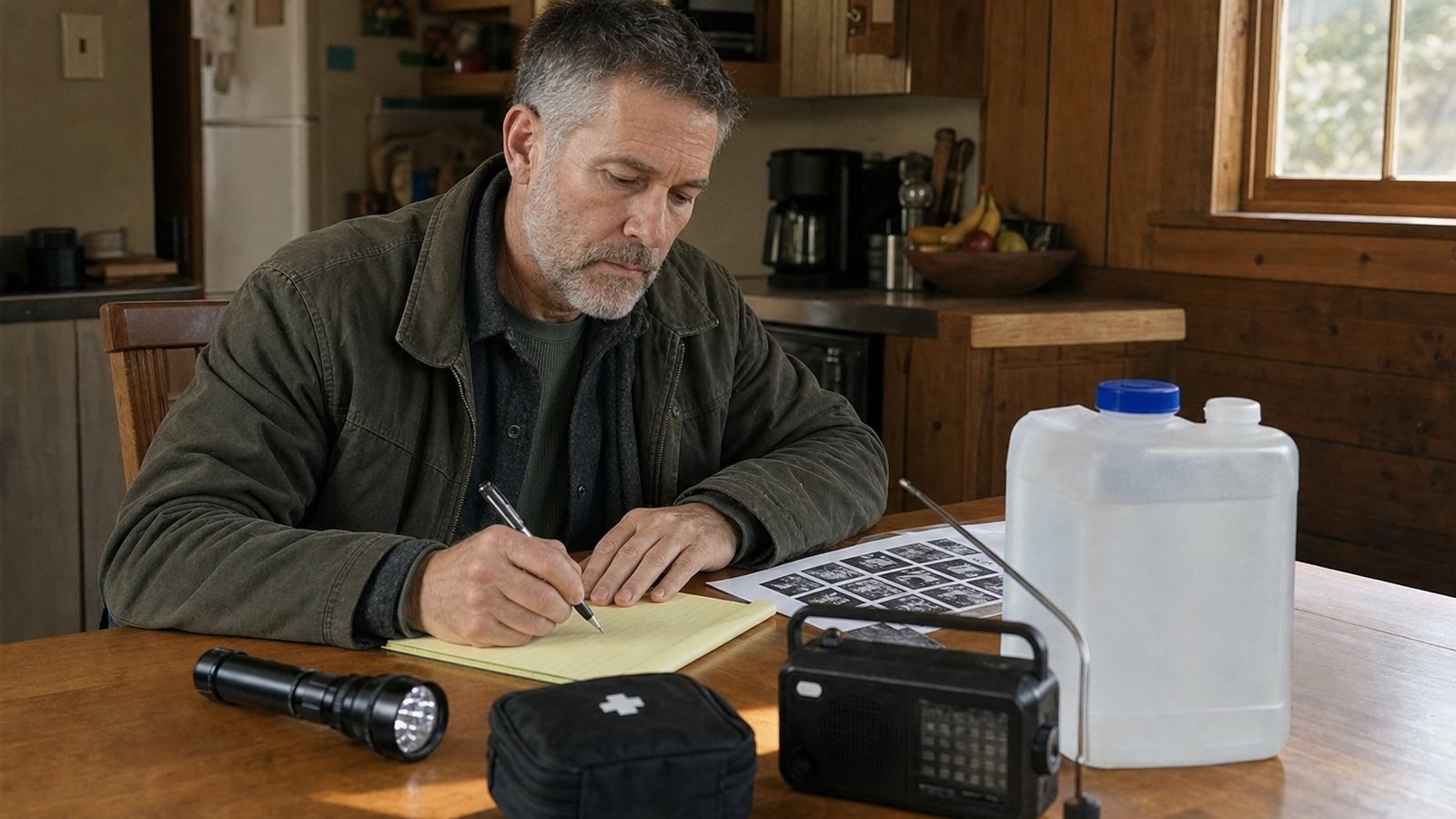
If you have already spent money on this, you are not behind. You are exactly the person this was written for. Water. Batteries. A radio. A first aid kit somebody gave you. Maybe a generator sitting under a tarp. None of that was a mistake — every one of them was the right instinct, and nobody ever told you the job had a second half.
Here is the second half. Supplies fail in five specific places, and not one of the five shows itself while the lights are on. Read them slowly. Answer each one out loud, about your own house.
If you hesitated on even one of those five, you already know something about your house that you did not know two minutes ago — and it cost you nothing. A real outage almost never breaks everything at once. It breaks one thing, and then everything else stands there waiting on that one thing. So the useful question was never “do I have enough?” It is: which one of mine goes first?
THE METHOD
Eight Systems Keep A Household Running. In An Emergency, The Weakest One Decides Everything.
In an emergency your house is not one thing that either holds or doesn't. It is eight things working at the same time.
You give each of the eight a score. Zero, one, or two. Honestly, standing in front of it — not from memory at the kitchen table.
Then comes the part almost nobody does: ignore the average. Eight systems, scored 0 to 2, means the best possible total is 16. A total of 11 looks like a good grade — and it can still hide one system sitting at zero. That zero is where your night goes wrong. You are not looking for your average. You are looking for your lowest one.
This is a procedure to run, not an encyclopedia to read. An encyclopedia is measured by how much it holds; a procedure is measured by whether you finish it. That is why this one ends on a weeknight.
AUDIT the eight systems → FIND the weakest one → FIX that one → TEST it, so you know it actually works → SET the date you check again → back to AUDIT
This is why buying more rarely fixes anything. A household with four flashlights and no agreed meeting point does not need a fifth flashlight.
THE FIRST SESSION
Six Answers, In Writing, By The End Of Your First Session
Not a feeling that you're better prepared. Six specific answers, written down, that you did not have this morning. Read number six last, and read it twice — it is the one that gets put off for years, and it takes four minutes at a kitchen table.
We say “first session” and not “in twenty minutes,” because we don't know your house. A couple in a two-bedroom apartment will move faster than a family of five with an elderly parent and two vehicles. What we can tell you is what comes out the other end: those six answers, on paper, in your own handwriting — and the quiet that comes with having finally done it.
$27 — one payment. Instant access, yours to keep. 30 days to ask for your money back at support@flowazy.com.
Every Federal Figure In This Manual Names The Agency It Came From, In The Agency's Own Wording, On The Same Page. Check Us Before You Trust Us.
You don't know who Martin Kellan is. That's reasonable, and it's the right question to be asking at this point on the page. Here is our answer: the manual is not built on him. It's built so that you never have to take his word for anything. Here is exactly how a figure appears on the page:
“Store at least one gallon of water per person per day for several days, for drinking and sanitation.” — Ready.gov
That is the wording, not our summary of the wording. Every figure in this manual appears the same way. Look it up. If the agency has changed its language since we printed, you'll find that too — and you should.
Now here is the part we are not going to charge you for. Eight of those figures are printed below, in full, with the agency named on each one. Take them. Write them on the inside of a cabinet door tonight. You do not have to buy anything to use them — and if all you ever get from this page is the twenty-foot rule on the generator, this page did you some good.
One more thing, and it's the kind of detail that tells you what this manual is. The current federal guidance on food and water says “several days.” It does not say three days. It does not say two weeks. Plenty of people selling preparedness will give you a hard number because a hard number sounds more confident. We print the official wording, because that is what the official wording says.
Sources cited throughout: Ready.gov / FEMA · CDC · USDA FSIS · National Weather Service · U.S. Forest Service · National Park Service · FDA · U.S. Army ATP 3-50.21

About Martin Kellan
Martin Kellan is a field guide and practical naturalist. He wrote this manual the way he works: go look at the thing, write down what is actually there, and put the source next to the number so somebody else can check it.
He is not a hero and he is not selling you one. He wrote it because he kept meeting people who had bought all the right things and had never once put them in an order — and because the official guidance that answers most of it is public, free, and scattered across seven agencies in a form nobody finishes reading. So he read it, and he put it on one page, in the order you'd actually use it.
That is the whole introduction. No service record, no certification, no list of credentials — because a manual that names its sources on every page does not need an author you are asked to believe in.
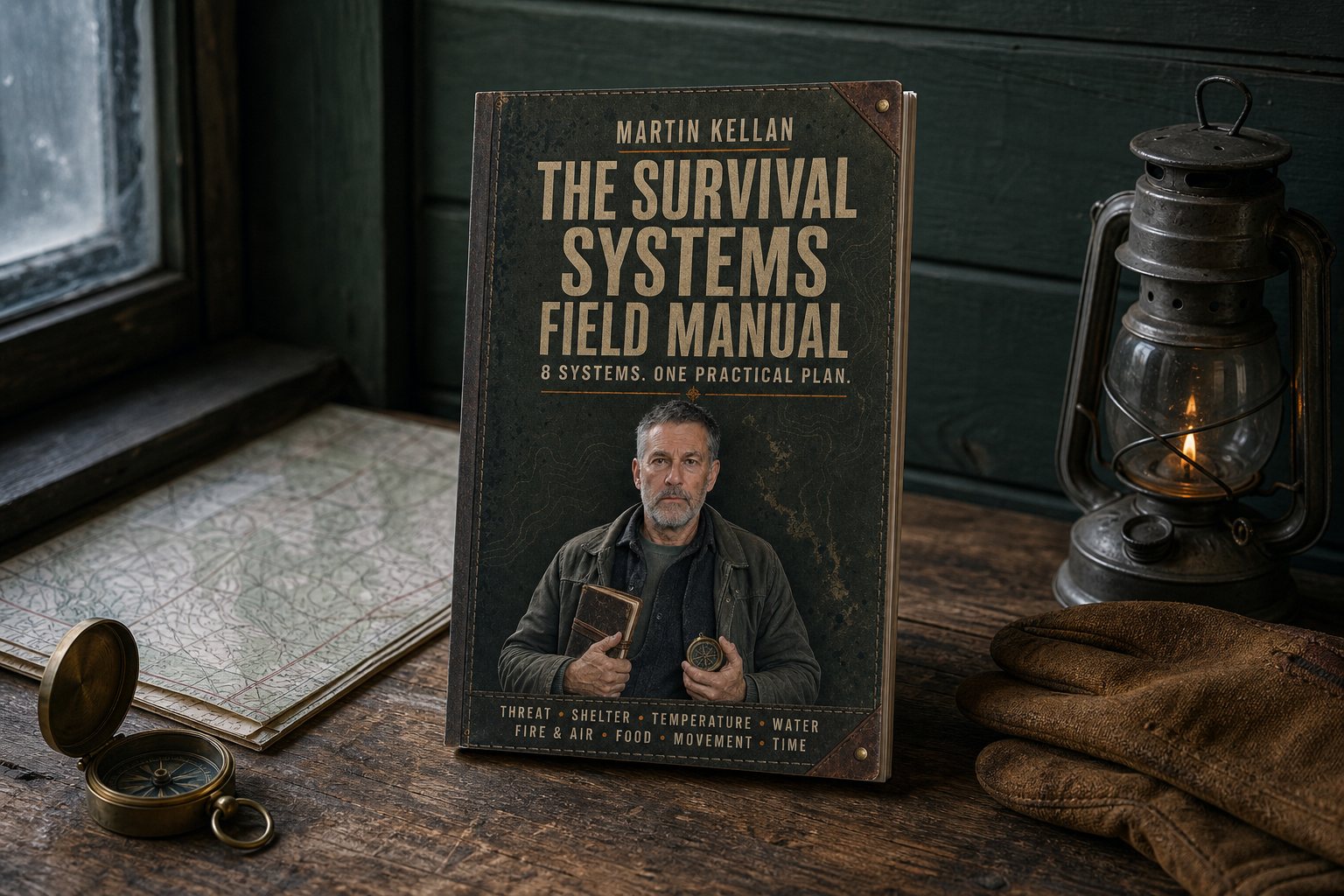
The Field Manual — 28 Pages, And None Of Them Are Filler
This is the reference you keep. It covers the eight systems one at a time, spells out what has to be true for each one to count as working, and then covers the things this specific group of readers actually deals with:
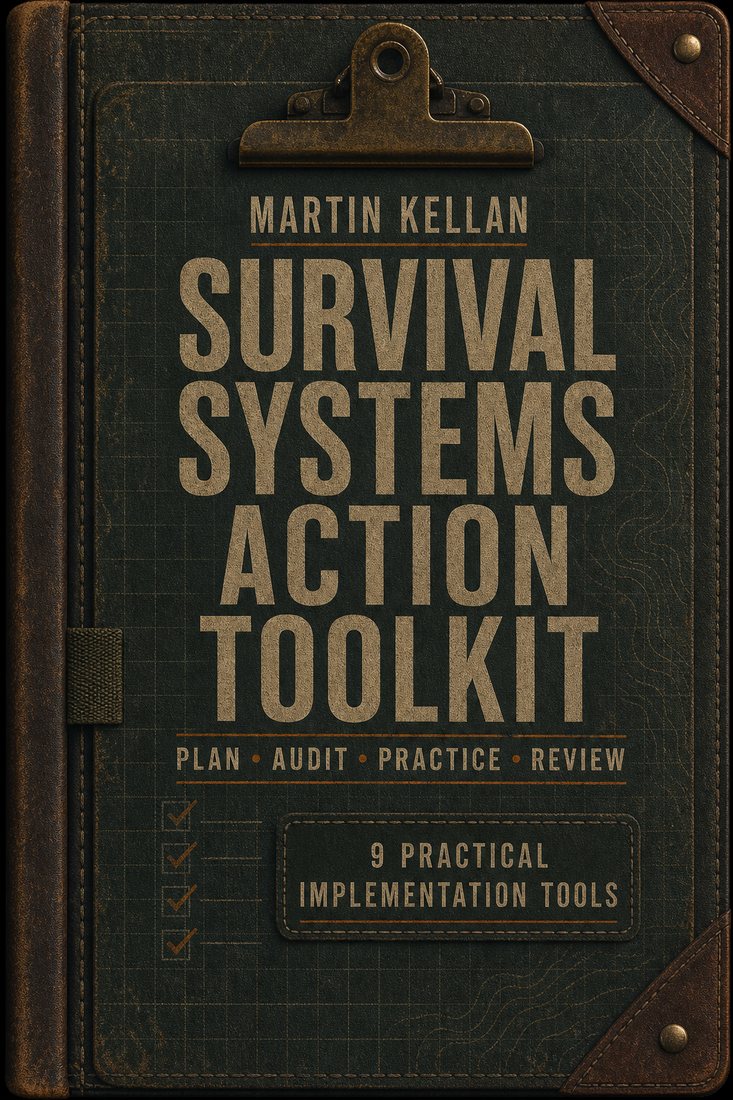
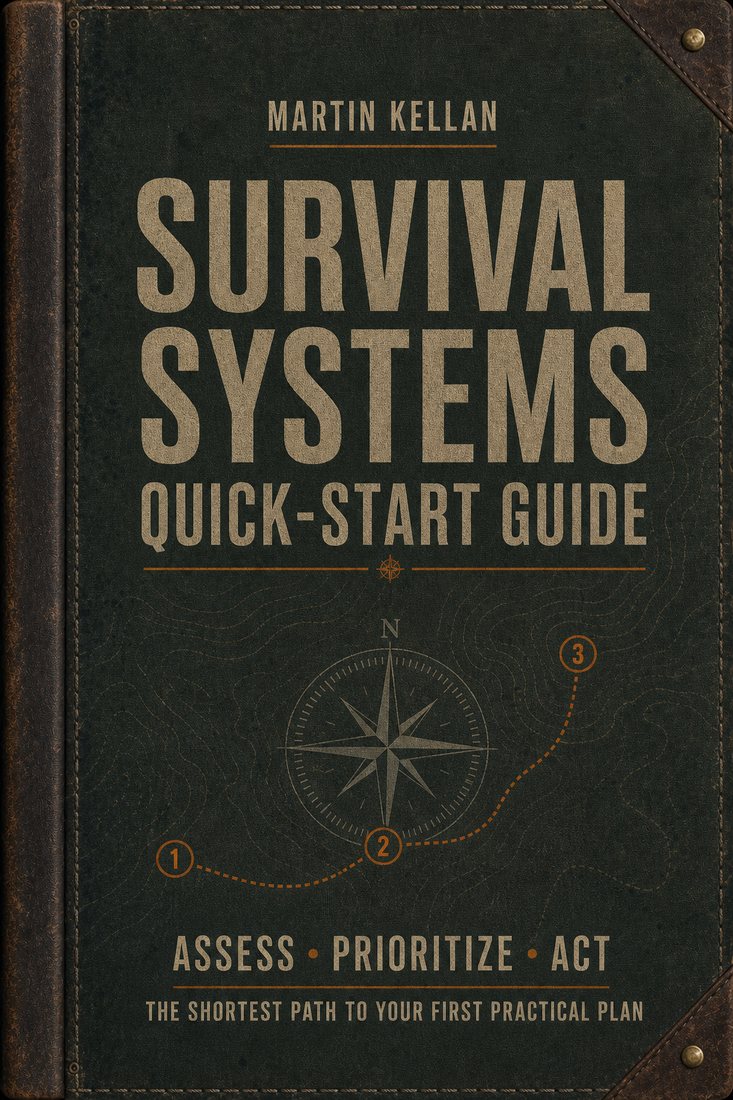
Reading Is Not Doing. The Toolkit Is Where You Do It.
Nine implementation modules. They are modules, not books and not bonuses — each one is a job with a place to write the answer.
1. 72-Hour Systems Build · 2. Eight-System Home Audit · 3. Stay-or-Leave Workbook · 4. Fire & Carbon Monoxide Card · 5. The 15-Minute Reset · 6. Seasonal Readiness Calendar · 7. Personal Information Card · 8. Vehicle Readiness Builder · 9. Carry Kit Customizer
A note on Module 1. “72-hour” is our build order, not a federal recommendation. Seventy-two hours is where you start because it's the smallest complete version of the plan — not because an agency told you that's how much to store. On how much to store, the manual prints the official wording, and the official wording is “several days.”
And the 7-page Quick-Start Guide
If you open five files and don't know which one to touch, nothing gets done. That's why the first file is seven pages long and does one job: it walks you from “I just bought this” to a plan you can actually use, in order, with a fill-in sheet at the end. Start there. Everything else waits for you.
The Planner Opens In Your Browser. What You Write Stays On Your Device.
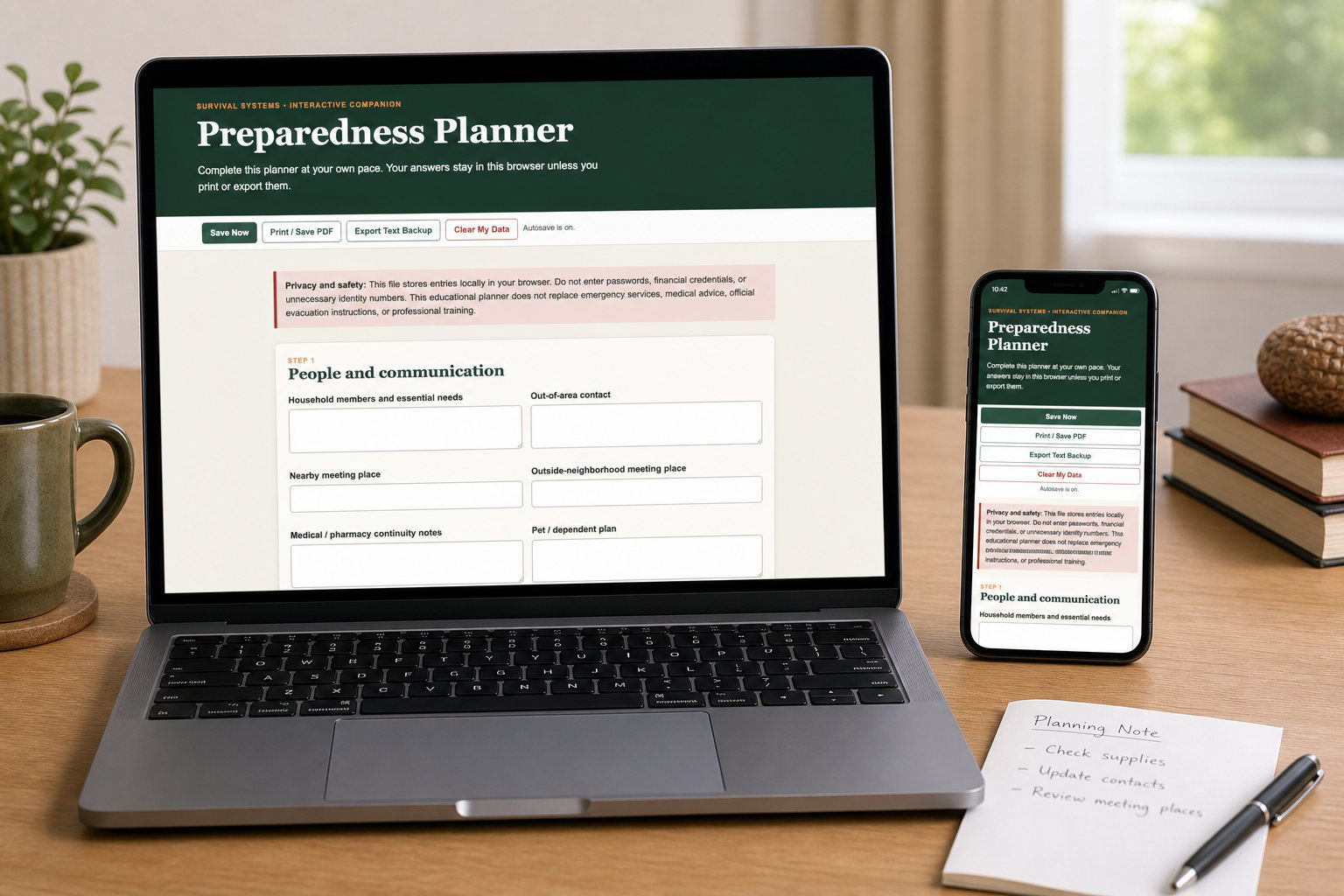
No app to install. No account to create. No password to remember. You open a file and it opens the way a web page opens.
One thing to know, and we would rather you know it now: because your answers are stored in your own browser and not on our servers, clearing your browser data can clear them. That is the trade for privacy. It's also why the planner exports a backup and prints — and why we tell you, more than once, to print the cards.
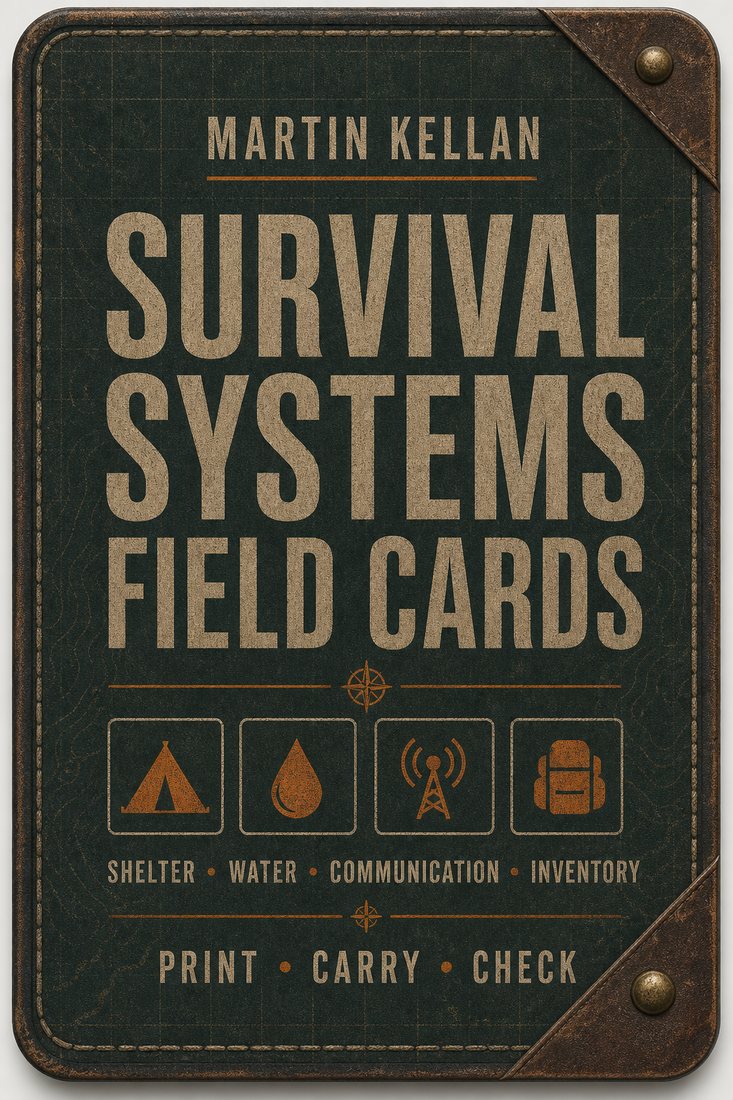
There Is Something Backwards About A Power-Outage Product That Only Exists On A Screen
Your phone is the thing that dies. The plan cannot live inside it. So four pieces of this bundle are built to leave the screen entirely. Print them, cut them, and put them where they get used.
The cards come as their own 6-page document, with its own printing instructions: print at 100%, not “fit to page,” and a note on where to post each one. There is also a privacy note, because two of these cards have your family's information on them.
Print them the week you buy this. A card you meant to print is worth exactly nothing.
The Order, So You Never Have To Guess What's Next
That's the loop. It doesn't change. Next season you run it again and it takes a fraction of the time, because you're re-checking instead of starting. That is what handled looks like — not a project you are always behind on, but a thing you did, on a date, that you can point to.
$27 — one payment. No subscription. Instant access, yours to keep. 30 days to ask for your money back at support@flowazy.com — one email, no reason needed.
Who This Is For — And Who It Isn't

This is for you if
You have already bought supplies and you're not sure they'd hold up together.
You want the plan finished, on paper, in a place you can point to — and then you want to stop thinking about it.
You are the person your household leans on, and you'd like to keep it that way.
You have a knee that doesn't cooperate, or a parent who lives with you, or equipment that plugs into the wall and cannot stop. This bundle has a section written specifically for that, and it is one of the most useful parts of the manual — not an afterthought.
You'd rather check a source than trust a stranger.
You're planning for a household interruption — an outage, a storm, a water advisory, a travel delay, an evacuation — not for the end of the world.
This is not for you if
You want field training. This is planning you do at a table. It does not teach wilderness skills and it does not replace hands-on instruction.
You want medical instruction. This is not medical advice and it is not first aid training.
You want anything to do with armed defense. That is not in here, in any form.
Questions People Actually Ask
I already have supplies. I've been doing this for thirty years.
Then you're starting well ahead, and this bundle isn't going to argue with you about what you own. It tests something else entirely: whether what you own is reachable, compatible with the rest of your gear, understood by everyone in the house, maintained, and backed up by a second, independent way of doing the same job. If all eight of your systems come out at a 2, the audit is short and you finish with it in writing. That is a fine outcome, and it's the one we'd want for you.
This is free government information, repackaged.
Partly true, and we'd rather say so than dodge it. The underlying guidance is public and free — Ready.gov, CDC, USDA FSIS, FDA and the rest — and we tell you exactly where each figure came from so you can go read it at the source. What is not free is the arrangement: that material is spread across dozens of pages from several agencies, it does not come scored, it does not come in an order of operations, and it does not come with a place to write your answer down. What you're paying for is the audit, the order, and the sheet. Not the data.
Who is Martin Kellan? I've never heard of him.
Fair — and you should not have to. He is a field guide and practical naturalist, and he built this manual so that you never have to take his word for anything: every federal figure names the agency it came from, in the agency's own wording, on the same page. You can use this document without trusting the author, which is the entire design. Read one page and you will see how it works.
I'm not an outdoors person.
You don't need to be. The eight systems are the same eight whether you are in a shelter you built or a house you have lived in for thirty years — the difference is that outdoors shows you the weak one right away, and a house hides it until the power fails, the water goes under an advisory, or the road out closes. This is the home version. It happens at your address, with your family, and nearly all of the work is done sitting at a table.
My wife thinks I'm being paranoid about this.
Then show her what actually comes out of it. Not a bunker and not a stockpile. Two meeting points. One phone number that still works when the local lines are jammed. A written list of what each person in the house needs and cannot do without. A card taped inside the panel door. That is the same kind of plan a workplace is required to put on a wall, and nobody has ever called a meeting point paranoid. The word people use for it is organized, and they usually use it afterward.
I've bought things like this before and never opened them.
That is the honest objection, and it is the one the design answers first. The Quick-Start Guide is seven pages and its only job is to tell you what to touch first, so you open one file instead of five. The first sitting produces six written answers. Then the loop tells you the date you look at it again, and you close the file. Open it once and finish one session and you are already past the part that most people never start.
Is this medical or rescue training?
No. It is educational planning. It does not replace emergency services, a doctor, a pharmacist, or professional instruction of any kind. The sections that touch on medication and medical equipment point you to your own doctor, your own pharmacy, and your own utility company — because those are the people who can actually act on it.
Does this guarantee my family's safety?
No. No responsible product can guarantee how an emergency turns out, and any page that tells you otherwise is telling you something it cannot know. What this can do is make sure the decisions that have to be made in advance were actually made in advance, and written down.
What makes this different from the other PDFs I've downloaded?
It's four PDFs and a browser planner, and the difference is what happens when you are done. Most preparedness material leaves you with things you read. This one leaves you with six answers in your own handwriting: two meeting points, an out-of-area contact, the essential needs of everyone in your house, a 0–2 score on all eight systems, one repair with a person's name and a test date on it, and a stay-or-leave trigger. Then it leaves you four cards to print, so the plan survives a dead phone.
How much is in the 61 pages?
Enough to finish, and nothing you have to wade through. Twenty-eight pages of manual, where every federal figure names the agency it came from, in the agency's own wording, on the same page. Twenty pages of workbook across nine modules, built to be written in. Seven pages that get you started, and six pages of cards made to be printed and carried. You can count all of it before you buy, which is more than most of this category will let you do. It is a procedure to run, not an encyclopedia to read, and that is the reason it ends.
I'm 68. Is this going to be too much for me?
The opposite. Three pages of the manual are written specifically for older adults and caregivers: a self-assessment across mobility, transportation, communication, medical dependency, assistive devices, and daily support — plus the utility priority restoration list, voluntary municipal registries, and FDA guidance on keeping medication going. Most preparedness material treats this as a footnote. Here it's a section.
What do I need to open it?
For the PDFs, anything that opens a PDF — your phone, your tablet, your computer. For the planner, any current web browser. There is no app, no login, and no subscription.
Do I need a printer?
For the four field cards, yes — and we'd push you to print them. That's the part built to work when the power is out and the phone is dead. If you don't have a printer at home, any print shop can do the 6-page card document for pocket change. Everything else can stay on a screen if you prefer.
Do you keep what I write in the planner?
No. The planner saves to your own browser, on your own device. Nothing is sent to us. We never see your meeting points, your contacts, or your medication list. The flip side is that clearing your browser data can clear your answers — so use the export button, and print.
Are there updates?
If we revise the material, we'll say so plainly on this page. We are not promising you ongoing updates, because we're not going to promise something we haven't built a system to deliver. What you buy is what's listed above, in the counts listed above.
Where are the customer reviews?
There are none on this page. Rather than borrow, stage, or write some, we left them out entirely. Judge this on what is listed above, and on the fact that every federal figure in it names the agency it came from, in the agency's own wording, on the same page — which is something you can verify without taking anyone's word for it.
How do I get it after I pay, and can I get a refund?
You get instant access the moment your payment goes through — all five components at once, on the same screen and in an email receipt, yours to keep. Nothing ships and nothing waits. On refunds: you have 30 days. Email support@flowazy.com within 30 days of buying and say you want a refund. You do not have to give a reason, and there is nothing to send back.
What This Is, And What It Isn't
This bundle is educational planning material. It is not medical advice, rescue instruction, or legal advice, and it does not replace emergency services, a physician, a pharmacist, or professional training. Nothing here guarantees an outcome.
Where this material refers to medication, medical equipment, or a medical condition, talk to your own doctor and pharmacist before acting on it. For utility service, call your utility company. For local registries, evacuation routes, and shelters, your local emergency management office is the authority. In an emergency, call 911 or your local emergency number first.
Figures are cited with the agency named on the page where they appear, as worded at the time of writing. Agencies revise guidance; if a figure here no longer matches the source, the source is correct and we want to know.
What You Receive, And What You'll Have Finished